Showing posts with label Testimony. Show all posts

Saturday, 14 September 2013

Oliver Barclay (1919-2013) made an immense contribution to evangelical Christianity worldwide

Oliver Barclaythe second General Secretary of what is now known as the Universities and Colleges Christian Fellowship (UCCF), was promoted to glory this week. 

Christian Medical Fellowship (CMF), for which I work, grew out of IVF/UCCF in 1949 and was founded by Oliver’s immediate predecessor Douglas Johnson (DJ), who features in this obituary abridged from the UCCF website.

Both Oliver and Douglas made an immense contribution to the growth of evangelical Christianity worldwide.

Oliver Barclay, a scion of the banking family and second General Secretary of IVF/UCCF, died at his home in Leicester yesterday, 12 September 2013, aged 94.

He was born in Kobe, Japan, on 22 February 1919, the son of Joseph Gurney Barclay (who served with what is now the Church Mission Society). His great grandfather was the MP Thomas Fowell Buxton who campaigned with William Wilberforce as part of the influential Clapham Sect.

Oliver first joined the small IVF team in 1945, having completed a doctorate in zoology.  His original hope was to teach in one of China’s newer universities, but Douglas Johnson, IVF founding General Secretary (always known as DJ), persuaded him to defer his departure by two years. It soon became clear that the universities of Britain and Ireland would instead be his life’s work.

Oliver Barclay served for two years as a wartime President of the Cambridge Inter-Collegiate Christian Union (CICCU) and as Chairman of the students’ national IVF Executive Committee.  From his days in Trinity College, Cambridge, he formed a lifelong friendship with John Stott, also at Trinity, and two years his junior. Both men would serve as lifetime Honorary Vice-Presidents of the CICCU.

As Chair of the student national IVF Executive, Oliver was privy to DJ’s plans that the IVF should found a Centre for Biblical Research in a university town, to strengthen the roots of the church in the then very liberal Theology faculties of the universities. What would soon become Tyndale House, Cambridge (secured in 1944 and opened in 1945) had originally belonged to a member of the Barclay family. It now hosts one of the finest libraries for biblical research in the world.

In 1953, Oliver became the first IVF Universities Secretary, supporting the IVF travelling secretaries [now UCCF staff workers] around the four nations. The liberal hold in the university theology faculties, and in the churches, created much opposition to evangelical influences among students.

In 1964 Oliver Barclay succeeded Douglas Johnson as IVF General Secretary. This was the same year his first wife, Dorothy, a consultant surgeon at the Royal Free Hospital (whom he had married in 1949) died of cancer, leaving four children. The following year, Oliver married Daisy Hickey, a family friend.

Oliver Barclay steered the Inter-Varsity Fellowship through its own significant expansion to engage with the times, as new universities and colleges were founded, and as a surge of change swept through societal norms.  In 1975 the movement’s name was changed to the Universities and Colleges Christian Fellowship (UCCF) to reflect the growing work in the polytechnics and colleges of education. Its publishing wing, by then known as Inter-Varsity Press (IVP), was the UK’s leading evangelical publishing house.

Oliver Barclay urged clear-thinking evangelical graduates to consider two major directions: to pursue an academic career; or if ordained to apply for vacant churches in university towns.  Gradually the tide of liberalism began to turn. Oliver was succeeded in 1980 by Robin Wells under whom from the mid-late 1980s the regional teams would be formed, opening the way for the appointment, under Bob Horn’s leadership, of the first relay workers.

In retirement, Dr Barclay continued to serve on the IVP long-range planning group, and was instrumental in the founding of the UCCF Research Council to oversee the work of Tyndale House in Cambridge and the new Whitefield Institute in Oxford. He was co-founder in 1989 of the journal Science and Christian Belief, joint organ of the Victoria Institute and of Christians in Science.

Oliver served on the Executive Committee of the International Fellowship of Evangelical Students (IFES) from 1959-1983, and as its chair from 1971-79. He served as an Honorary Vice-President from 1983-91, and was always particularly thrilled to see its pioneering work pass into the hands of national leaders. This global movement now has presence in over 150 nations.

Oliver Barclay wrote several books including Evangelicalism in Britain 1935-1995 (IVP, 1997) and in the 1980s he edited a book series entitled When Christians Disagree. He had no formal theological training but developed in himself – and cultivated in his staff – the ability to ‘think theologically’. He read through Calvin’s Institutes each year and prayed daily for a deeper understanding of the meaning of the death of Christ. He never lost sight of his dual task, to strengthen a witness to Christ both in the student world and among faculty.

We thank God for Oliver Barclay’s tenacity and far-sightedness, his shrewd judgment and his passion for the gospel; and we commend his widow Daisy and his four children to your prayers.

Sunday, 25 August 2013

Do you know what happened to the girl in this iconic Pulitzer prize winning photo from the Vietnam War?

On 8 June 1972, a plane bombed the village of Trang Bang, near Saigon (now Ho Chi Minh City) in South Vietnam after the South Vietnamese pilot mistook a group of civilians leaving the temple for enemy troops.

The bombs contained napalm, a highly flammable fuel, which killed and badly burned the people on the ground.

The iconic black-and-white image taken of children fleeing the scene won the Pulitzer Prize and was chosen as the World Press Photo of the Year in 1972.

It communicated the horrors of the Vietnam War in a way words never could, helping to end one of the most divisive wars in American history and later becoming a symbol of the cruelty of all wars for children and civilian victims.

In the centre of the photo was a nine year old girl, who ran naked down the highway after stripping off her burning clothes.

Kim Phuc Phan Thi was with her family at the pagoda attending a religious celebration when the plane struck and lost several relatives in the attack. The children running with her were her own brothers and sisters.

I had the privilege of hearing Kim speak at a meeting in New Zealand a few years ago and the 40th anniversary of the bombing was commemorated last year.

She said, looking back, that three miracles happened on that dreadful day.

The first was that, despite suffering extensive third degree burns to her left arm, back and side, the soles of her feet were not burnt and she could run.

The second was that after she collapsed and lost consciousness the photographer, Nick Ut, took her to Barsky Hospital in Saigon.

The third was that her own mother found her there later that day whilst searching for her children.

Kim remained hospitalized for 14 months, and underwent 17 surgical procedures, until she recovered from the burns.

Grateful for the care she had received she later decided to study medicine but struggled to come to terms with her deep physical and psychological scars.

‘My heart was exactly like a black coffee cup,’ she said. ‘I wished I died in that attack with my cousin. I wish I died at that time so I won’t suffer like that anymore ... it was so hard for me to carry all that burden with that hatred, with that anger and bitterness.’

But it was as a second year medical student in Saigon that she discovered a New Testament in the university library, committed her life to following Jesus Christ, and realised that God had a plan for her life.
 
Kim never finished medical school as the communist government of Vietnam realised the value of the ‘napalm girl’ value as a propaganda symbol.

She believed that no man could ever love her with her disfigurement but later studied in Cuba where she met Bui Huy Toan, another Vietnamese student whom she married in 1992.  
Kim and Toan went on their honeymoon in Moscow. During a refuelling stop in Gander, Newfoundland, they left the plane and asked for political asylum in Canada, which was granted. 

In 1994, UNESCO designated her a Goodwill Ambassador for Peace.

In 1997 she established the first Kim Phuc Foundation in the US, with the aim of providing medical and psychological assistance to child victims of war. Later, other foundations were set up, with the same name, under an umbrella organization, Kim Foundation International.

Her biography, The Girl in the Picture, written by Denise Chong was published in 1999.
 
In 2004, Kim spoke at the University of Connecticut about her life and experience, learning how to be ‘strong in the face of pain’ and how compassion and love helped her heal.

On 28 December 2009, National Public Radio broadcast her spoken essay, ‘The Long Road to Forgiveness’.

Kim Phuc, now 50, lives near Toronto, Canada, with her husband and two children, Thomas and Stephen.

She has dedicated her life to promoting peace and providing medical and psychological support to help children who are victims of war in Uganda, East Timor, Romania, Tajikistan, Kenya, Ghana and Afghanistan.

‘Forgiveness made me free from hatred. I still have many scars on my body and severe pain most days but my heart is cleansed. Napalm is very powerful, but faith, forgiveness, and love are much more powerful. We would not have war at all if everyone could learn how to live with true love, hope, and forgiveness. If that little girl in the picture can do it, ask yourself: Can you?’ (Kim Phuc, 2008)


I know that my redeemer lives, and that in the end he will stand on the earth.
And after my skin has been destroyed, yet in my flesh I will see God;
I myself will see him with my own eyes—I, and not another.
How my heart yearns within me! (Job 19:25-27)

References

Saturday, 24 August 2013

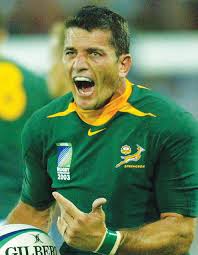
Springbok rugby hero Joost van der Westhuizen, dying from motor neurone disease, speaks of his Christian faith

 Joost van der Westhuizen is a name well known to rugby fans the world over.

It was the scrum half’s try saving tackle on the towering All Black wing Jonah Lomu in the World Cup rugby final in 1995 which arguably won the tournament for South Africa.

He went on to win the Tri Nations in 1998 and captained the Boks at the 1999 World Cup, when they were beaten in extra time in the semi-finals by eventual winners Australia.

The 42 year old is now dying of motor neurone disease (MND) which he contracted in 2011. Progressive muscular weakness has now left him in a wheelchair and barely able to speak.

This last week the BBC and Daily Mail have both run articles about which give testimony to his strong Christian faith.

Van der Westhuizen scored 38 tries in 89 Tests for the Springboks after making his international debut against Argentina in Buenos Aires in 1993.

He played his last match in the Green and Gold against New Zealand in Melbourne in November in 2003, retiring as South Africa’s most-capped player.

Since being diagnosed with MND, he has set up the J9 Foundation, which is a charity that raises awareness about the disease.

Despite his personal plight, van der Westhuizen said he’s made peace with his situation.
‘I realise every day could be my last’, he told BBC Sport.

‘I led my life at a hundred miles an hour. I’ve learnt that there are too many things that we take for granted in life and it’s only when you lose them that you realise what it is all about.’

‘It’s been a rollercoaster from day one and I know I’m on a deathbed from now on. I’ve had my highs and I have had my lows, but no more. I’m a firm believer that there’s a bigger purpose in my life and I am very positive, very happy,’ he said.

‘I know that God is alive in my life and with experience you do learn. I can now talk openly about the mistakes I made because I know my faith won’t give up and it won’t diminish. It’s only when you go through what I am going through that you understand that life is generous.’

For Van der Westhuizen, life is now chiefly about spending time with his family. He has two children, Jordan, seven, and a five-year-old daughter, Kylie.

This testimony makes a welcome change for the BBC which usually highlights motor neurone disease in the context of the debate around legalising assisted suicide debate. But van der Westhuizen’s testimony opens a window into what is the more usual reality for most sufferers.

There are in fact 5,000 people in the UK with MND, of whom around 1,000 will die from the disease each year, three each day.

The vast majority do not want help to end their lives but assistance to live as comfortably as possible in the days they have left.

I have already drawn attention on this blog to Alistair Banks’ inspiring story of courage. Dubbed ‘the incurable optimist’ (right) he finally passed away on 9 January this year but a tribute site, and his blog are still available along with a statement from the Motor Neurone Disease Association for which he did so much.

His family speak of being ‘so very proud of the way that despite the disease he inspired so many people and left such an incredible legacy for his children and others’.

His optimism was not unusual, he maintained.

'Everyone I know with MND is trying to do positive things, otherwise they would sink into despair. It’s a coping mechanism. Doing things means that you can pull in friends and family to share something both fun and rewarding.'

Earlier this year the inspirational film ‘I am Breathing’ was promoted as part of motor neurone disease awareness.

It follows the last few months of Neil Platt’s life, seeing him go from being a healthy 30 something to becoming completely paralyzed from the neck down from MND. As his body gets weaker, his perspective on life changes. His humour remains, but a new wisdom emerges:

‘It's amazing how adaptable we are when we have to be. It's what separates us and defines us as human beings.’

Another Briton with MND, Rev Michael Wenham, has told the Independent about his determination to keep on living life. Diagnosed in 2002 with a rare, slower form of Motor Neurone Disease, Michael has always intended on not giving up.

In his book, 'My Donkey Body' he clearly and compassionately describes the process of being diagnosed with the terminal disease, and the struggle of living with the condition. He also deals eloquently with these issues on his blog.

A few years ago on a visit to South Africa I was able to link him with another South African Christian with MND, Jozanne Moss,  with whom he later co-authored ‘I choose everything’. The book is available on Amazon, has its own face book page and is recommended by the Motor Neurone Disease Association

Jozanne died in February 2012 and there is a beautiful tribute to her on Michael’s blog, which ends with a quotation he believes would fit Jozanne from Charles Dickens:

‘Have a heart that never hardens, and a temper that never tires, and a touch that never hurts.

We all will one day die, unless Christ’s return comes first, but for most the dying process will be far easier than for those with MND. 

This is precisely why these stories of triumph over adversity from those facing death with this frightening disease should get more column inches and air time. They give strength to others and are a refreshing balance to the negative images we often get of the dying process from the media.

Stories of hope in the face of suffering can bring reality, courage and hope to a society that so desperately needs them. Let’s please have more of them. 

Wednesday, 16 May 2012

Mum beats lung tumour after refusing to sacrifice her baby to save her own life

There is an inspiring story in the Daily Mail this morning about a 21 year old mother who beat cancer after refusing to sacrifice her unborn child.

Daniella Jackson was diagnosed with a tumour in her left lung shortly before discovering she was pregnant and refused doctors' advice to abort her child so they could operate on her.

After a difficult pregnancy she gave birth to healthy girl and then had an operation to remove the tumour along with half her lung. According to the Metro report, the tumour was a carcinoid, a slow-growing tumour with a good outcome relative to other lung tumours.

Carcinoid lung tumors generally have a better outlook than other forms of lung cancer. Persons with carcinoid lung tumors have an overall 5-year survival rate of 78%-95% and a 10-year survival rate of 77%-90%.

A year on, she is the proud mother of Rennae – her second child – and has been told that she is free of disease.

A devout Roman Catholic, Miss Jackson has said that aborting her child was never an option because of her strong faith: ‘I was always determined to have my baby. I felt such a close bond with her, I couldn’t let her go.’

Abortion to save the life of the mother makes up a miniscule fraction of the 200,000 abortions carried out each year.

In the UK it was reported in 1992 that in the first 25 years of the operation of the Abortion Act 1967 only 0.013% of all abortions were performed 'to save the life of the mother' and it is even questionable whether many of these required such radical action. The 2009 Abortion Statistics for England and Wales do not record any on these grounds.

Usually when the mother's life is at risk from an ongoing pregnancy, the baby is at a viable age and so can be saved simply by bringing forward the time of delivery. However on very rare occasions doctors may say it is necessary to terminate an early mid-trimester pregnancy (13-22 weeks) in an emergency in order to save the life of the mother.

But it is so rare that many obstetricians will not see a case personally in a lifetime of practice.

Even Alan Guttmacher, former President of the pro-abortion US Planned Parenthood Federation said as long ago as 1967:

'Today it is possible for almost any patient to be brought through pregnancy alive, unless she suffers from a fatal illness such as cancer or leukemia, and if so, abortion would be unlikely to prolong, much less save life'.

In fact, women with cancer will often forgo chemotherapy, and in this case surgery, for the sake of the baby.

Daniella did not know whether she would survive from her illness, but such was her love for her baby that she was willing to take the risk and if necessary lay down her life for her. Now she has the joy of caring for and treasuring her daughter and seeing her grow up. One day maybe, at the other end of life, it will be Rennae caring for Daniella.

I wish Daniella and Rennae all the best in their life together and pray that the strong faith in God and self-giving love that has led both to Rennae’s birth and Daniella’s survival will continue to grow.

Reading their story has encouraged me and I hope that by sharing it this testimony will be equally an encouragement to others to rejoice at how precious human life is and to thank God for his faithfulness and self-giving love in sending Jesus to lay down his life for us because he couldn't let us go.

Jesus said, ‘Greater love has no one than this: to lay down one’s life for one’s friends’. And he demonstrated that love by going to the cross to pay the price for our sins, so that he could share not just this life, but all eternity with us. He loved us that much.

You see, at just the right time, when we were still powerless, Christ died for the ungodly. Very rarely will anyone die for a righteous person, though for a good person someone might possibly dare to die. But God demonstrates his own love for us in this: While we were still sinners, Christ died for us. (Romans 5:6-8)

Tuesday, 18 October 2011

The big interview from Evangelical Times

I gave an interview last month for the October Evangelical Times ‘big interview’ column. It is posted on their website but I have also pasted it below.

The big interview – October 2011

Peter Saunders is Chief Executive of the Christian Medical Fellowship, a UK-based organisation with 4,500 UK doctors and 1,000 medical students as members. His role includes leadership training, teaching evangelism and ethics, medical mission, writing, editing and media work. Peter took some time out to answer questions from Sheila Marshall.

SM Which TV drama series — Holby City, Casualty or ER?

PS Definitely ER. As a general surgeon I loved the challenge of assessing and treating critically ill patients. Holby City and Casualty are just too ‘soapy’ and too slow-moving for me.

SM What drives your work with CMF?

PS Luke the physician tells us that Jesus sent his followers out ‘to preach the kingdom of God and to heal the sick’ (Luke 9:2). This means, to attend to the spiritual and physical needs of a suffering world. Christian doctors motivated by Jesus’ teaching and example have been profoundly influential in shaping healthcare’s history. A significant number of medicine’s pioneers were people of faith — Paré, Pasteur, Lister, Paget, Barnado, Jenner, Simpson, Sydenham, Osler, Skudder, Livingstone and many more. The CMF exists to help doctors continue in the steps of Jesus, the Great Physician. What drives me is a desire to help doctors fully integrate their faith and practice, to be witnesses to the gospel, and instruments of God’s grace and compassion.

SM Why does CMF need to promote Christian values in the church?

PS CMF’s fourth aim (after evangelism, discipleship and healthcare mission) is ‘to promote Christian values, especially in bioethics and healthcare, among doctors and medical students, in the church and in society’. As Christian doctors, rooted in Scripture and dealing daily with a host of physical, psychological and spiritual needs, we are uniquely placed to bring medicine and the Christian faith together. Members are often asked by Christian friends for guidance on end-of-life care, abortion, infertility, contraception and a host of other lifestyle and healthcare issues. Many pastors feel they lack the expertise to apply the Bible to contemporary issues of healthcare and medical ethics. Christian doctors can help fill that gap. We want to help Christians make wise decisions about their own healthcare and want to equip Christians to engage in the wider national debate on issues that have a significant effect on the most vulnerable people in our society.

SM Can Christian values be promoted in a secular society?

PS As Christians we are called to proclaim the gospel and live to honour Christ in every way. This involves bringing a Christian mind to the many issues that plague our society, and being salt and light. As citizens of a democracy, we have a responsibility both to choose our political leaders and to do what we can to ensure that the laws in our statute books are just and fair. We have a special responsibility to stand up for those who have no voice, like those who are poor, marginalised, elderly, unborn, sick and disabled. There is a growing hostility amongst some quarters of our country towards Christian faith and values. This needs to be challenged.

SM Are Christian values too expensive for our welfare system?

PS The current crisis in healthcare has complex causes. Much of the rising burden of disease is a consequence of poor lifestyle choices, such as people literally eating, smoking, drinking and drugging themselves to death. There is little money free to invest in care, because we are spending our financial resources on the wrong things or living way beyond our means. This is compounded by the breakdown of the family. I believe that the root cause is that as a society we are increasingly turning our back on God, so the supports of family, church and community are no longer there. Christian faith has huge benefits for health, because it has a huge impact on lifestyle choices; people are more likely to avoid or delay many of the diseases that are costly to our health service. If more people in Britain lived according to Christian values, there would be less medical need and much more money available to care for the sick and dependent.

SM What issue did you take with Terry Prachett’s recent BBC documentary on assisted suicide?

PS The BBC has become something of a cheer-leader for assisted suicide. This was the fifth BBC documentary in three years that portrayed assisted suicide or euthanasia in a positive light. We are disturbed by the bias of our national broadcaster, which has an obligation to remain impartial. The programme also breached both national and international guidelines on suicide portrayal and posed a great risk to vulnerable people by fuelling the well-documented phenomena of suicide contagion and copycat suicide.

SM How should the media approach this subject?

PS The BBC’s own editorial guidelines on portrayal of suicide are very clear. They call for, ‘great sensitivity’; ‘factual reporting and fictional portrayal of suicide, attempted suicide and self-harm have the potential to make such actions appear possible, and even appropriate, to the vulnerable’. The World Health Organisation’s guidance is equally unambiguous: ‘Don’t publish photographs or suicide notes. Don’t report specific details of the method used. Don’t give simplistic reasons. Don’t glorify or sensationalise suicide’.

SM Can you give examples?

PS Media stories about how people coped positively with suicidal feelings lead to a decrease in levels of suicide in the general population. Researchers have named this protective effect the ‘Papageno effect’, in honour of the character in Mozart’s opera The magic flute. When Papageno fears that he has lost his love, Papagena, he prepares to kill himself. But three boys save him at the last minute by helping him to find purpose in his suffering.

SM Are euthanasia, abortion and bioethics matters of conscience?

PS The Bible teaches us that human beings are made in the image of God and infinitely precious — meaning worthy of respect, protection, empathy and compassion. The sixth commandment ‘You shall not kill’ is based on this idea and forbids taking the lives of innocent human beings, even if they request us. For centuries the laws of our country have been based on these biblical concepts. Moral issues are not simply matters of individual conscience. It takes a huge amount of grace, courage and character to obey God in tough, costly decisions, but that doesn’t mean that it should not be clearly and unambiguously taught. That is why there is so much moral teaching throughout Scripture.

SM How can everyday believers make a difference?

PS God uses weak and ordinary people to do great things. The smallest step of faithful obedience by God’s grace can turn the course of history. God can use day-to-day decisions to advance his kingdom in and through us. Nothing done in his service is ever in vain and our job is to be faithful to him where he has placed us and trust the results to him.

SM What verses inspire you?

PS Too many to mention really, but here are just a few: Luke 4:18-19 — the Nazareth manifesto; 1 Corinthians 15:58 — never give up; 2 Corinthians 8:9 — Jesus our model; 2 Corinthians 12:9 — strength in weakness; Proverbs 31:8 -9 — speaking up for the weak.

Sunday, 7 August 2011

Matt Hampson – awe-inspiring must-read article in Sunday Times on coping with tetraplegia

'Engage!' was the last word Matt Hampson heard before dislocating his neck while in rugby training with other young England hopefuls. On a cold, grey, overcast day in 2005, the cream of young English rugby gathered at a Northampton training ground. Matt Hampson, 'Hambo' to his mates, was one of them. He had dreamt of playing rugby for England ever since he had picked up a rugby ball at school. His skill, conviction and dedication had brought him to the cusp of realising that dream, in an England U21 team that included Olly Morgan, Toby Flood, Ben Foden and James Haskell. But as the two sets of forwards engaged for a scrum on the training field, the scrum collapsed and Matt, who played tight-head prop, took the full force of two opposing sides. In that moment his life changed forever.

The Sunday Times carries this morning an extended piece on Matt Hampson which is a must-read. If you don’t have an on-line subscription go out and snap up a hard copy. He has also recently been interviewed on BBC1 (watch here).

I once had the privilege of spending half an hour with Matt (pictured), who ended up permanently paralysed from the neck down and on a ventilator after the accident, but now runs a charity to support people who are, in his own words, ‘less fortunate than himself’. ‘I don’t think about what I can’t do. I think about what I can do’, he told me.

I can’t reproduce the whole Sunday Times article here but have pasted a few excerpts below:

On his parents

I drank too much in the first two years after my accident; some of it to remember, most of it to forget, but I never lost sight of the pact I had made with my father at Stoke Mandeville one night. He had come straight from work on his own and maybe it was the reality of my condition hitting home or a fight he had had with Mum but he was oozing pain from every pore.

We sat in silence for what seemed an eternity, trying to find some positive that might emerge from my injury. And trying. And trying. It was desperate. There was nothing; just the whoosh of the ventilator taunting us. Then I said: ‘I think it will make me a better person in the long run, Dad.’ I didn’t mean it and I’m not sure I believed it but I’d have said anything to ease his pain and it seemed to give him a lift.

A month later, I gave my first interview since the accident to The Sunday Times but the stand-out quote was my father’s: ‘One thing Matthew said to me which I couldn’t believe was, “I’ll be a better person for this in the long run, Dad.” I thought it was an amazing thing for a 20-year-old to say. I don’t think I could have said it.’

And that was it. I would strive to be a better person. I had promised Dad.


On vulnerability

We abandoned our meal and were halfway down Broad Street when the battery went flat. The ventilator stopped. There was nothing going into my lungs and I was suddenly gasping for breath.

Think of a fish a moment after it is plucked from the sea; watch it thrash up and down on a harbour wall and imagine how that might feel. Except that you can’t; not the shock or the vulnerability or the sheer f****** terror of it, not even when there’s a plan B.

As Tom was dispatched at speed to the van for another battery, Jacqui whipped the tube from the cuff on my neck and replaced it with a small rubber bellows stored permanently in the emergency bag. Then, cupping the device with her hands, she began pumping air into my lungs.

As we waited for Tom to return, each minute felt like an hour. I did my best to appear calm but couldn’t avert my gaze from Jacqui’s fingers. It must feel very odd indeed to hold a human life in your hands, and, though she applied herself with steely concentration, there was no disguising the strain.

Meanwhile, it was business as usual for shoppers on Broad Street. Nobody offered to lend a hand. Nobody offered to call an ambulance. There we were, stranded on one of Britain’s busiest streets, and it was as if a paralysed man being given a blow-job was the most natural thing in the world.


On Daniel James

Daniel James was also a paralysed rugby player but became a household name in October 2008 when he ended his life at the Dignitas suicide facility in Zurich, Switzerland. Hampson describes going to meet him some months earlier:

The first thing that struck me was that he had come down from the ward on his own — he didn’t have a carer supporting him. The second thing was how reluctant he was to engage. I encouraged him to focus on the possibilities, not the problems, and spoke of some of the things I had enjoyed since leaving hospital. The sun kissing my face on a warm summer’s day. The smell of fillet steak grilling on the barbecue. The laughter of friends sipping beer in the garden. The Six Nations championship and autumn internationals at Twickenham. The pleasure of watching Leicester Tigers, my old rugby club, beat Wasps. The Christmas tasting menu at Gordon Ramsay’s in Chelsea.

‘But make sure you bring your wheelchair,’ I joked, ‘because you won’t be able to walk out of there.’ It just seemed to wash over him. He wasn’t interested in talking about the future. He just wanted me to go.


Favourite Movie

A scene from The Shawshank Redemption, my favourite movie, always helps me to refocus. It’s the one where Andy Dufresne, the main character, who is in jail for the murder of his wife and her lover, has come out of a long spell in solitary and is telling his friend Red about Zihuatanejo, a warm place on the Pacific ocean in Mexico.

He asks his friend to join him if he ever manages to get out of prison. But Red isn’t sure.

‘I don’t think I could make it on the outside, Andy. I’ve been in here most of my life. I’m an institutional man now.’ And then (Andy) says it, the greatest line in the history of cinema, and my creed: ‘I guess it comes down to a simple choice really — get busy living or get busy dying.’


As I have argued before, stories of triumph over adversity like Matt’s should get more airtime and column inches. They are a wonderful ray of hope.

Matt’s biography, ‘Engage: The Fall and Rise of Matt Hampson’ is released on 18 August. The Sunday Times is selling it for £14.99 (cf retail price of £16.99) but you can pre-order it on Amazon for £11.29 including free delivery.

Wednesday, 27 July 2011

Stories of triumph over adversity should get more column inches and air time

Today Nikki Kenward, who was left disabled after a partial recovery from paralysis caused by Gullain Barre syndrome, will stage a protest outside parliament about the dangers that a changing the law to allow assisted suicide or euthanasia would pose to those with serious disability.

Her own inspiring personal story is told in the Daily Mail today and well worth a read.

Kenward (pictured) wants particularly to draw attention to Ms M, a woman in her early 50s in minimally conscious state, whose case is currently being heard in the Court of Protection. M’s sister and partner wish to have her nutrition and hydration withdrawn so that she can be starved and dehydrated to death.

It has long been a ploy of the pro-euthanasia movement that allowing the death by dehydration of people who are not imminently dying will make lethal injections for euthanasia much easier for society to accept. It is in other words part of a softening up exercise. So there is understandingly a lot of public interest in this landmark case which has the potential of setting very dangerous legal precedents. The judge visited M on Monday this week and expert witnesses will be giving evidence today.

It is a popular misconception that most people with serious disability or terminal disease wish to have their lives prematurely ended. But in fact this is true only of a very small vocal minority to whom the BBC in particular, that 'cheerleader for euthanasia', has given an international platform. This has had the effect of swaying public opinion and fuelling suicide contagion.

But more recently there has been a steady trickle of ‘good news’ stories in the print media of people overcoming adversity, of which Nikki Kenward’s is the latest. I have also recently blogged about other examples – amongst them are:

1.Martin Pistorius, a South African man who was imprisoned by locked in syndrome for ten years but is now married and running a successful computer company.

2.Alistair Banks, the incurable optimist, – an inspiring story of courage in the face of motor neurone disease.

3.Pauline Thiele, who learnt to love her unborn baby son Liam, who had Edwards syndrome, even though she knew he could not survive .

4.Jean-Dominique Bauby, the French editor of Elle magazine, who suffered a severe stroke, from which he never recovered, and yet wrote, the autobiographical ‘Diving Bell and the Butterfly’ which was ‘dictated’ letter by letter and has been made into a major feature film.

5.Little Charley-Marie Skinner, a baby born with a heart tumour, whose parents were advised to have an abortion. She is now thriving at 19 months.

6.Graham Miles, the pensioner who told how he beat ‘locked in syndrome’ after suffering a massive stroke.

7.Matt Hampson, the Leicester rugby player who suffered tetraplegia in a collapsed scrum and now is an inspirational speaker running a charity to help those ‘less fortunate than himself’.

8. Gary Parkinson, who has locked-in syndrome, and his now acting as a scout for his old football club Middlesborough.

Proponents of assisted suicide, who have expressed a strong persistent wish to be ‘helped to die’ by their own hands, have been granted an international platform by the BBC, to tell their stories in great detail and without adequate cross-examination, creating the false impression that the small minority they constitute are somehow representative of all people facing suffering or death.

Cases are often highlighted in painstaking detail featuring long personal interviews and often with substantial extraneous information about the individual’s personal life. Contrary views are either not expressed, or are at best relegated to single sentence reactionary soundbites. Many of the cases involved have become household names in the UK.

It is therefore gratifying to see news outlets, other than the BBC, giving column inches to cases like those I have outlined above. It is essential that people here this alternative perspective on suffering and assisted suicide.

I recently noted how the soap Emmerdale, had more realistically depicted the devastating effect on those left behind following the assisted suicide of one of its key characters, even though it had previously been much less accurate in depicting what life with paralysis involves for most people.

These recent trends are encouraging. Stories of courage in the face of profound disability or chronic or terminal disease and accounts of how people found strength to overcome adversity, or even to cope with a life situation which they would never have chosen but have no power to change, need to be heard.

Is it too much to ask that some of them might be given an international platform by the BBC? We will have to wait and see.

Tuesday, 26 July 2011

Alistair Banks: the incurable optimist – an inspiring story of courage in the face of motor neurone disease

Recently I blogged about Martin Pistorius – an inspiring story of faith, hope and love in the face of locked-in syndrome.

It was equally refreshing to read today in the Daily Telegraph the story of a man with motor neurone disease, ‘Alistair Banks: the incurable optimist’.

This is just the kind of inspiring testimony of which we should be hearing much more.

Just a few paragraphs to whet your appetite:

On the face of it, Alistair Banks does not have much to be optimistic about. Last year he was diagnosed with motor neuron disease (MND), and he is likely to die before very long. Aged only 40, the thought of leaving his wife and two small children brings tears to his eyes. He can no longer walk, let alone continue to work as a teacher. Yet his perky face is currently smiling out from billboards all over the country under the description: ‘Alistair, the Incurable Optimist’.

Where others in his position may be thinking of heading off to Dignitas in Switzerland to put an end to it all, or railing against the laws that prevent assisted suicide in this country, he is making the most of every minute left to him.

His optimism is not unusual, he maintains. 'Everyone I know with MND is trying to do positive things, otherwise they would sink into despair. It’s a coping mechanism. Doing things means that you can pull in friends and family to share something both fun and rewarding.'


The overwhelming vast majority of people with diseases like motor neurone disease, multiple sclerosis and Parkinson’s disease – or even locked in syndrome for that matter - do not wish to end their lives.

They want help and support from others to make the very most of the lives that they have. Not ‘assisted dying’ but ‘assisted living’.

Matt Hampson, the Leicester prop who lost the use of all four limbs after a rugby scrum collapsed once told me the secret of his battle with disability. ‘I don’t think about what I can’t do, but what can still do’, he said.

Tuesday, 19 July 2011

Wonderful testimony – ‘the whole rollercoaster ride had been worth every bump, just to be able to hold my tiny son’

I mentioned earlier this week the wonderful story of a woman who resisted pressure to have an abortion when her baby was discovered to have a tumour in her heart. Her daughter is now 19 months old and doing well.

Babies with serious disabilities don’t always have such good outcomes however. But even when there is no real hope of survival love and hope do not have to die.

There is an amazing testimony in the British Medical Journal today titled ‘Destined to Die’ about an Australian woman, Pauline Thiele, who discovered her baby was affected by Trisomy 18 or Edwards’ syndrome.

Edwards’ syndrome is a complex chromosomal disorder, in which there is an extra 18th chromosome. Children with this disorder have limited capacity for survival, and severe developmental delay is usual in survivors. Most children end up dying very early in life, usually of cardiac or respiratory failure.

Pauline’s description of her reaction in hearing the diagnosis is gut wrenching:

‘My world felt like it had been turned upside down and I listened in stunned silence as he tentatively told me that our 18 week old baby was not going to live. Any glimmer of hope that I had been holding onto disappeared. The weekend was tumultuous and I struggled with the realisation that the dream of raising this child would never happen.’

But when the baby moved she said she ‘knew that I loved this little one and would not take his or her life with a termination.’

Although some of her family’s initial reactions were not helpful she was supported by her mother and four friends. However, apart from a supportive GP, the lack of understanding she received from other doctors made things very difficult.

‘Without any referral to genetic counselling or paediatrics my decisions were based solely on information retrieved from the internet and I was left feeling abandoned by the medical profession.’

Eventually she tracked down four American paediatricians via the internet who provided her information by email. Later she discovered a local paediatrician and palliative medicine specialist who offered to support her through the birth. But then movements stopped at 36 weeks and it confirmed that her baby’s heart had stopped beating.

‘With a midwife’s firm guidance Liam was born quickly. Tenderly I held my son and realised that the whole rollercoaster ride had been worth every bump, just to be able to hold my tiny son. After delivery our paediatrician entered the room and cradled my son tenderly, gently patting him on the bottom. Watching this interaction, I felt my heart swell with love for my son and in gratitude to this man for the fight that he had fought. Conversing easily, the paediatrician commented, “If a baby can know stress in utero then surely it can know love. Liam knew that he was loved.” These words made the whole experience worth the heartache—just for my son to know that he was loved.’

Monday, 18 July 2011

A life precious to God – how to cope when you find your unborn baby has special needs

There is a deeply heart-warming story in the Daily Mail today titled, ‘Doctors told us to abort our little girl as she wouldn't survive birth - but our little fighter has flourished’

When an ultrasound scan showed ‘a massive tumour covering the entire left chamber of her heart that was restricting blood flow’ Charley-Marie Skinner's parents Heather and Andy were informed that there was little chance she would survive her birth and were advised to have an abortion.

They refused and were glad that they held their ground.

Now Charley-Marie (pictured) is nineteen months old and thriving – and if she does eventually deteriorate and require surgery the tumour may well be operable.

I have lost count of the number of times I have heard stories like this. Why is it that the medical profession responds in this knee-jerk fashion recommending abortion for disabilities we would make every effort to treat or correct in a baby after birth?

Why are not more parents given the opportunity, with proper support, to see their babies’ births through? Why is it that offering surgery, other treatment, or if relevant terminal care, to disabled, sick or dying babies seems no longer to be regarded as a serious option?

Why has our society instead reached the conclusion that these most vulnerable members of the human race, because they are disabled, sick or dying, have lives that are somehow not worth living? That they are, in other words, better off dead?

Recently released abortion statistics revealed that between 2002 and 2010 there were 17,983 terminations in Britain on the grounds that there was a ‘substantial risk’ that the babies would be ‘seriously handicapped’ — known as Ground E abortions. The overwhelming majority of these ‘abnormalities’ were compatible with life outside the womb.

Of the 17,983, a total of 1,189 babies were aborted after 24 weeks, the accepted age of viability, after which there must be such a serious risk for an abortion to be legal if the mother is not in danger.

A few years ago we carried in the CMF Student journal Nucleus, the story of a baby whose parents opted to love and care for her even though she had abnormalities that were not compatible with life outside the womb.

But they still went through with it and gave her all the love and care they could in the few hours their daughter Jennifer had with them.

I’d thoroughly recommend reading their testimony, ‘A life precious to God’.

The author Karen Palmer, a Christian psychiatrist, makes a powerful case for choosing to give birth to a disabled baby rather than having it aborted.

All pastors and prospective parents should read this, lest they are ever called to advise or cope with the arrival of a little one with extra special needs.

I leave the closing comments to Karen (but do please read her whole story):

Why did it happen? I don't believe that we can always know the reason God allows these things to happen. There's a spiritual battle going on and often the devil appears to have his way. What we do know is that God our loving Father, cushioned us and sustained us with his grace. It wasn't him who hurt us - he hurt with us.

What did we learn? We learned that God is intimately involved with us and with a tiny baby. We learned that even such a tiny, damaged life is precious to him. We learned better how to care for each other and our parents and friends. Our church learned how to care for us. We saw that terminating a pregnancy where there is an abnormality denies the parents and wider family the opportunity to grieve and remember a real and valuable member of that family. We learned that God answers prayer.

After Jennifer's death, a steadfast friend said that when Jennifer arrived in heaven there would be great rejoicing and celebration because of all she achieved in her short life. I dream that when I arrive there people will say 'Ah! You're Jennifer's mother' and I'll be so proud!

Sunday, 17 July 2011

Martin Pistorius – an inspiring story about faith, hope and love through ‘locked in syndrome’

The Sunday Times today tells the story of Martin Pistorius, a South African man who ended up paralysed and comatose following a throat infection at the age of 12. His awareness began to improve four years later and by the age of 19 had fully returned.

However it was a further five years before a therapist noticed that he was trying to communicate. The penny eventually dropped that he had been aware of everything going on around him for almost ten years whilst everybody had assumed he was unconscious.

Now, ten years later aged 36, he is married and runs a computer business despite being still in a wheel chair with limited limb movement and using computerised speech.

I see that the Daily Mail actually ran the story over a week ago (I missed it at the time) and there is a powerful review by Dominic Lawson of his autobiography, ‘Ghost Boy’ in the Sunday Times today.

I’d highly recommend reading all these accounts if you can access them (you need a subscription for the Sunday Times).

One of the most striking aspects of the story to me was the extreme range of attitudes in the people who cared for him. Lawson writes:

‘He learns that… nurses can be monsters as well as saints. In the latter category there is Virna, who with aromatic oils tirelessly massages away the muscular knots in his inert frame and talks to him lovingly all the while. At the other end of the moral spectrum, a carer addresses him as “piece of shit”, feeds him so brutally he vomits, and then shovels the sick back down his throat. A nurse at the same clinic gives him a bath-time enema so forcefully he bleeds, and then dips a toothbrush into the cloudy water before wiping his teeth with it. Yet another would make sure that she could be alone with him, and then uses his body as a tool for her solitary pleasure, before “wiping herself off on me”.’

‘Locked-in syndrome’ is a rare neurological disorder characterized by complete paralysis of voluntary muscles in all parts of the body except for those that control eye movement. It may result from traumatic brain injury, diseases of the circulatory system, diseases that destroy the myelin sheath surrounding nerve cells, or medication overdose.

Individuals with locked-in syndrome are conscious and can think and reason, but are unable to speak or move. The disorder leaves individuals completely mute and paralyzed. Communication may be possible with blinking eye movements. While in rare cases some patients may regain certain functions, the chances for motor recovery are usually very limited.

There have been some inspiring stories of people with locked in syndrome rising above their disabilities and regaining some function – including the recent British cases of Kate Allatt, Graham Miles and Nikki Kenward.

But the account that made the condition famous was that of Jean-Dominique Bauby, the French editor of Elle magazine, who suffered a severe stroke, from which he never recovered.

Aided by a therapist he learnt to communicate by blinking his left eye, the only part of his body that wasn’t paralysed. He described his experiences in the book he ‘dictated’ letter by letter, ‘The Diving Bell and the Butterfly’, which was later made into a 2007 film of the same name. He died three days after the book was published in 1997.

If you haven’t seen the film I would thoroughly recommend it. I was particularly struck by the way Bauby, after being initially suicidal, was able to find meaning and purpose in the face of immense suffering and to value what function he had left. He said the two things that his condition could not take away for him, were his memory and his imagination.

I once had the privilege of spending half an hour with Matt Hampson (pictured), a Leicester rugby player, who ended up permanently paralysed from the neck down and on a ventilator after a scrum collapsed, but now runs a charity to support people who are, in his own words, ‘less fortunate than himself’. ‘I don’t think about what I can’t do. I think about what I can do’, he told me. ‘I can still talk and feel, and I can still smell a steak cooking on the barbecue. And when I dream at night I can still play rugby.’

After you have spent time in the company of such people, you wonder how you can justify complaining about anything ever again.

Many naturally assume that people who suffer from such devastating conditions must necessarily end up in deep despair but given the right support and encouragement, it is remarkable what the human spirit is capable of.

For Pistorius, Bauby and Hampson, loving relationships which helped to sustain them through the hard times, were crucial in their ability eventually to find hope in the midst of their suffering.

Pistorius says of his wife, Joanna, that ‘it was she who has taught me to understand the true meaning of the Bible passage we were having read at the service: “There are three things that will endure – faith, hope and love – and the greatest of these is love.” My life has encompassed all three and I know the greatest of all is indeed love, in all its forms. I’d experienced it as a boy and man, as a son, brother, grandson and friend, I’d seen it between others and I know it could sustain us through the darkest of times.’

It is perhaps somewhat ironic that Pistorius’ case is being highlighted just a day before the Court of Protection reviews the case of Ms M, a woman in her 50s suffering from ‘minimally conscious state’ which she contracted after a bout of encephalitis. M’s mother wants to remove her feeding tube in order that she can be starved and dehydrated to death.